Clear Definitions
On-Chain
1 min read
Pronunciation
[on-cheyn]
Analogy
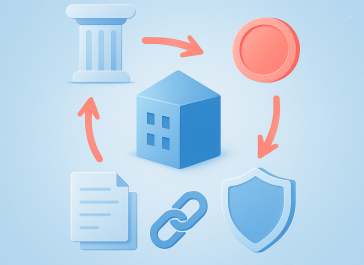
On-chain is like having a conversation in a public town hall meeting that's officially recorded in the minutes—everyone can verify what was said, the record becomes part of permanent public history, and changing it later would require extraordinary measures affecting the entire system.
Definition
Activities, transactions, or data that are processed, recorded, and stored directly on a blockchain. On-chain operations are verified by network validators, become part of the immutable ledger, and inherit the security and transparency properties of the underlying blockchain.
Key Points Intro
On-chain transactions represent the core, consensus-validated operations of a blockchain network.
Key Points
Recorded permanently on the blockchain and verified by all network validators.
Inherits the blockchain's security, decentralization, and immutability properties.
Typically incurs fees proportional to the computational or storage resources used.
Provides the highest level of settlement assurance but with lower speed and higher cost.
Example
A Bitcoin transfer recorded on the Bitcoin blockchain is an on-chain transaction—it's processed by miners, requires confirmations, incurs mining fees, and once confirmed, becomes a permanent part of Bitcoin's transaction history that cannot be altered.
Technical Deep Dive
On-chain operations must follow the strict consensus rules of their blockchain and consume scarce block space, which creates inherent scalability limitations. Every validator must process, verify, and store these operations, placing practical constraints on transaction throughput, data size, and computational complexity. This distributed verification creates the core security model of blockchains but also leads to their primary scaling challenges. Different blockchains make different trade-offs regarding what data and computation happens on-chain versus off-chain, with Bitcoin being highly conservative (primarily tracking ownership transfers) while platforms like Ethereum enable more complex on-chain logic through smart contracts at the cost of higher resource requirements.
Caveat
While on-chain operations provide the strongest security guarantees, they may be unnecessarily resource-intensive for many use cases that don't require the full security model of a decentralized blockchain, leading to the development of various off-chain scaling solutions.
On-Chain - Related Articles

11 min read
BlackRock & Franklin Templeton Tokenized Funds — What Their Moves Mean for RWAs
When Franklin Templeton pioneered tokenized money market funds on public blockchains, it opened the door for institutional adoption....
Read
14 min read
On-Chain Identity — KYC, AML & Zero-Knowledge Proofs
Institutional RWAs demand strict KYC/AML compliance. Blockchain's ethos values pseudonymity and data minimization....
Read